
 App Store ↗
 Google Play ↗
THE REVIEW
Sports and multi-game collections with AI condition estimates
Cardly AI’s appeal is the combination of a broad named game list and condition-estimate tools. For a large cataloguing project, paid scan limits and the separate batch-scanning purchase deserve particular attention.
Games and card-language editions.
Pokémon, MTG, Yu-Gi-Oh!, Digimon, Lorcana, One Piece; sports cards
English interface; card-language editions not enumerated
From photo to binder
A card photo produces identifying fields including name, set, expansion, rarity and number. Saved scans can be grouped into collections and marked as duplicates or favorites.
This is a sensible layout for sorting a mixed box: identify the card, confirm the record, then decide whether it belongs in a main binder, a duplicate group or a favorites list.
Games and card languages
The developer names Pokémon, MTG, Yu-Gi-Oh!, Digimon, Disney Lorcana and One Piece, plus major sports categories. That makes the stated scope broader than a Pokémon-only scanner.
Apple lists English for the interface. The listing does not provide an edition-by-edition card-language matrix, so game coverage and interface language should be treated as separate fields.
Collection value and condition estimates
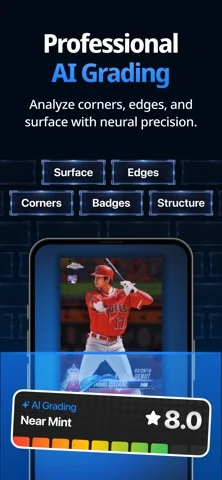
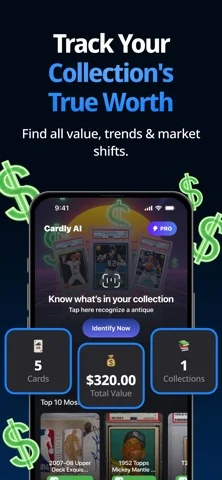
The portfolio features include estimated collection totals, price history and lowest or average market prices. AI Grading adds a visible-condition estimate intended to help select cards for a professional submission.
The estimate is most useful as a sorting aid within the collection workflow. It is distinct from the identification fields and from a grading company’s encapsulated grade. The app also includes a collector-focused AI chat for set and rarity questions.
Purchases and full-collection scanning
The US App Store lists weekly premium purchases at $5.99 and $6.99, annual options at $39.99 and $49.99, a $14.99 monthly subscription and a separate $9.99 Batch Scan purchase. These are listed purchase options rather than a single universal price.
In an August 10 developer reply on Apple, Scate confirms that scanning limits exist for premium members. That makes the current allowance an important selection criterion for a full binder or several thousand cards.
Export and platform choice
Matching Scate listings are available for iPhone and Android. Collection grouping is documented; a downloadable collection-file export is not described in the sources checked.
If your end goal is a spreadsheet, choose around a documented export path. Cardly AI’s clearer published strengths are recognition, organization, pricing context and AI condition estimates.
Latest iOS update
Version 1.7.5 arrived on September 16, 2026. The release note covers bug corrections and user-experience refinements. It does not announce a new game category or a revised scan allowance.

Editorial feature score: 6/10.
Five documented feature criteria, each worth up to two points. How we compare apps.
- Card scanning: 2/2. Camera-based card identification is documented in the official app listing; access limits are assessed under free access.
- Game breadth: 2/2. Six named TCGs plus sports cards.
- Collection management: 2/2. Collections, duplicates, favorites and total value documented.
- Exports: 0/2. No documented export found in sources checked
- Free access: 0/2. Free download listed, but ongoing free scanning allowance not documented.
Latest iOS release.
Version 1.7.5 · Released 2026-09-16. Read the developer’s release notes ↗.
Cardly AI: your questions.
Is Cardly AI legit?
Cardly AI is listed on the Apple App Store by SCATE DIJITAL PAZARLAMA ANONIM SIRKETI. The official links in this review identify that publisher’s app, its store ratings and release history.
Is Cardly AI the same as CardlyMon?
No. Cardly AI is published by Scate; CardlyMon is published by Applus.
Which TCGs does Cardly AI list?
Pokémon, MTG, Yu-Gi-Oh!, Digimon, Lorcana and One Piece.
Does premium mean unlimited scanning?
The developer confirms premium scan limits in its Apple review response.
Can it estimate a card grade?
Yes. Its AI Grading feature estimates visible condition to help with submission decisions.